You can now purchase the Second Rupert Journal “The Secretary, the Shaman, the Scholar, the Lobbyist, the Publicist, and the Virtuoso”
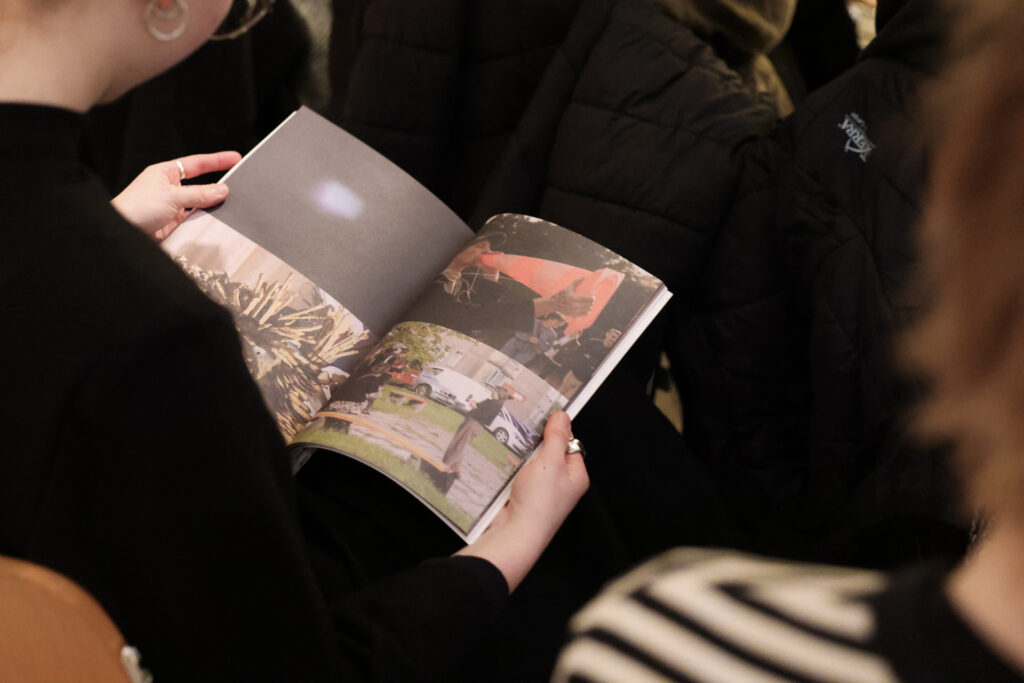
This is not a catalogue nor a report, but a container of texts, notes, poems, diagrams, doubts, and glitches – gathered from the participants and tutors of Rupert’s Alternative Education Programme (AEP) 2025. It is a folder for questions, a constellation of practices that marks the programme’s process. The archetypes that framed our year – the secretary, the shaman, the scholar, the lobbyist, the publicist, and the virtuoso – are not metaphors but methods, muscles, and positions through which artistic labour unfolds. Today’s artists are expected to be not just creators, but also administrators, producers, financiers, and strategists of their practice, constantly shifting between different modes of work. Yet, do we have the tools to embrace the many roles we must play to sustain our work, with confidence? The Rupert Journal 2 marks the end of the AEP 2025 and invites a broader readership to rethink and reflect on the position of an artist today, as a set of tools and sensitivities.
We were inspired by José Esteban Muñoz, a foundational thinker in queer theory and performance studies, who describes disidentification as a strategy of resistance – one that allows marginalized communities to navigate dominant social and ideological structures without fully assimilating or outright rejecting them. Instead, they negotiate, subvert, appropriate, and reinterpret. Perhaps artists, too, employ disidentification as a way of working – moving within and against the systems that shape their practice, adapting and repurposing the tools at hand.
We read Andrea Fraser as one of the visionaries who offers a bird’s-eye view of the artistic self within a larger ecosystem, prompting us to consider whether, with our choices, we resist or reproduce the status quo. She deconstructs the contemporary art field, proposing that it has fragmented into relatively segregated subfields: art market, exhibition, academic, community-based, and activism – each operating under different economies, discourses, and systems of value. Instead of a singular art world, we are agents of a complex ecosystem where struggles over power, legitimacy, and value define an artist’s position and practice.
Editor: Goda Palekaitė
Designers Jana Sofie Liebe, Augustinas Milkus
English Language Editor Connor Manship
Lithuanian Language Editor Evelina Zenkutė
Translators Aistis Žekevičius, Emilija Ferdmanaitė
Coordination Assistant Gustė Kripaitė
Printer Petro Ofsetas
Alternative Education Programme 2025 Participants
Charles de Agustin
Luisa Berghammer
Alexandra Bondarev
Marta Finkelštein
Janina Fritz
Charline Gdalia
Anton Karyuk
Oscar Mathieu le Bussy
SUNRS
Chris Tegho
Tutors
Agnė Bagdžiūnaitė
Kris Dittel
Futurefarmers
Adrijana Gvozdenović
Carina Erdmann
Level Five
Robertas Narkus
Jonas Palekas
Vijai Maia Patchineelam
Kate Rich
Soft Power (Linnéa Bake and Eva Herrmann)
Rupert Team
Director Viktorija Šiaulytė
Curators of the Residency and Public Programmes JL Murtaugh, Monika Lipšic
Curator of the Alternative Education Programme Goda Palekaitė
Coordinators Aistė Frišmantaitė, Ioanna Valavanis
Head of Partnerships Agnė Liukaitytė
Communication & Digital Content Manager Aistė Marija Stankevičiūtė
Curatorial Assistants Gustė Kripaitė, Connor Manship
AEP Photographers Dominyka Gurskaitė, Andrej Vasilenko
Partners
This edition was developed in partnership with Goethe Institute (LT), KASK Curatorial Studies (BE), Level Five (BE), MORPHO (BE), Radvilla Palace Museum of Art (LT) and WIELS (BE).
Funding
Alternative Education Programme – it’s workshops, studio visits, and the final event “The Secretary, the Shaman, the Scholar, the Lobbyist, the Publicist, and the Virtuoso” have been financially supported by:
Lithuanian Council for Culture
Vilnius City Municipality
Tech Zity
Parts of the programme were also supported by New Perspectives for Action, a project by Re-Imagine Europe, co-funded by the European Union and Lithuanian Culture Institute.
Rupert Journal is funded by the Media Support Foundation.